






 Spell
 Quick
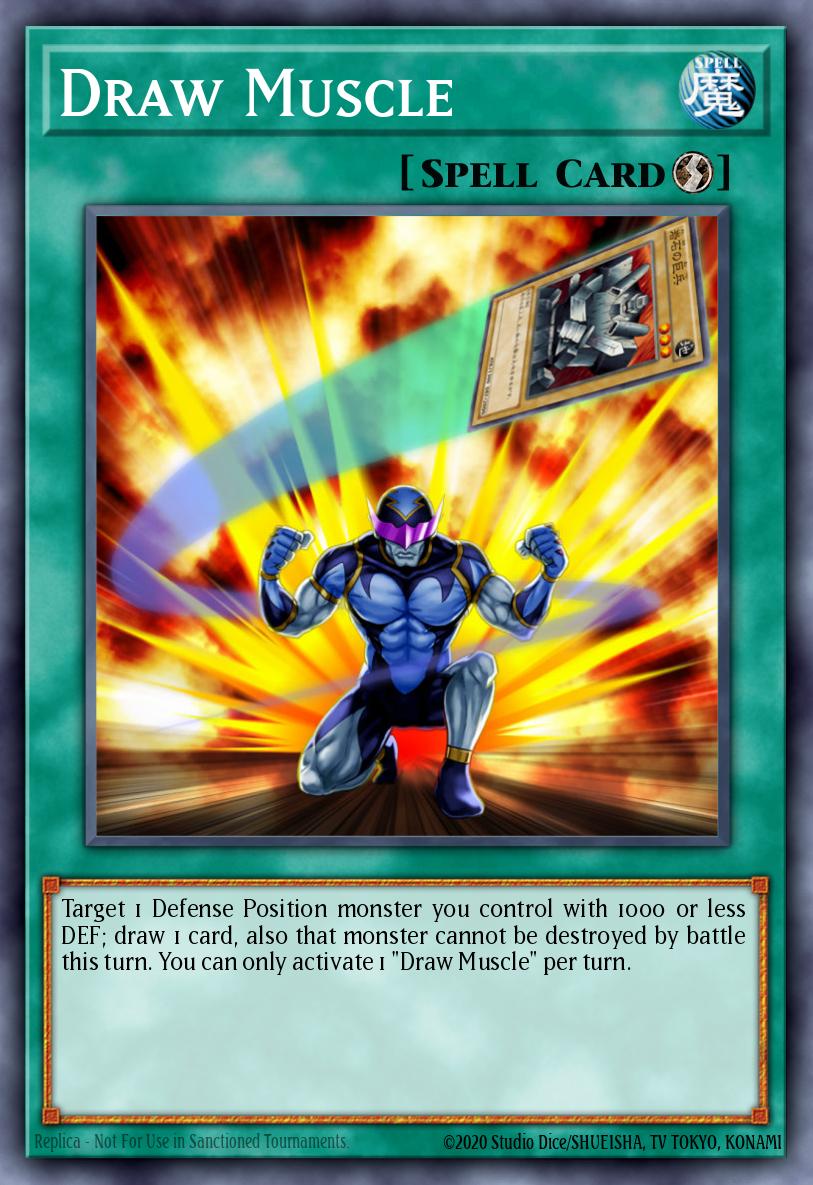
Draw Muscle
View:
644
Target 1 Defense Position monster you control with 1000 or less DEF; draw 1 card, also that monster cannot be destroyed by battle this turn. You can only activate 1 "Draw Muscle" per turn.

Draw Muscle — Power Evaluation
Final Score: 44 ± 8 · Confidence: Medium
- Intrinsic: 41.5 · Deck: 45.1 · Meta: provisional
- Primary role: Utility
Why it scores here
Draw Muscle converts one spell into one drawn card, so its resource value is card-neutral: a cantrip that replaces itself rather than generating advantage. Its real cost is a board condition, a Defense Position monster with 1000 or less DEF, which limits when it is live, and its battle-protection clause is minor. Presence in 57 decks across 22 archetypes confirms it is a reliable generic draw that fits many homes, not that it is strong. High stats played no part, and the score stays modest because no combo data exists to show what it converts into.
Axis scores
| Axis | Score | Evidence |
|---|---|---|
| Accessibility | 45 | Needs a face-up monster in Defense Position with 1000 or less DEF on your field, so it is conditional rather than live in an opening hand (verified text; deck spread across 22 archetypes is observed). |
| Combo & Conversion | 25 | No combos_evidence rows; the card only draws one card and protects one monster for the turn, so conversion is text-only inference (inferred). |
| Resource Economy | 50 | Spell that draws one card for itself, which is net-neutral card advantage rather than a gain (verified text, inferred net value). |
| Effect & Interaction | 15 | No opponent interaction beyond a battle-destruction shield on your own monster for the turn (verified text). |
| Material Utility | 0 | A Quick-Play Spell has no body and cannot be used as material (verified card type). |
| Resilience & Flexibility | 30 | Quick-Play Spell that a spell negation or removal of the targeted monster in response can stop; it is once per turn, so it has limited redundancy (inferred from text and once-per-turn wording). |
| Deck-Building Efficiency | 70 | Single-slot, no garnet or lock, legal in TCG, OCG, Master Duel and Duel Links, with 3 copies allowed on Duel Links (verified legality; observed copy distribution: 48 of 57 decks run one copy). |
Calculation
Weight profile: Utility / no clear role (default), no secondary blend. Intrinsic ≈ 41.5, Deck ≈ 45.1, Meta = provisional. Modifiers: none. Final formula: 0.40*Intrinsic + 0.60*Deck (decks present, combos absent, meta unknown)
Strengths
- Cheap, single-slot cantrip that is legal in all four listed formats
- Broad home distribution: 22 archetypes and two gameplay types
- Protects one of your own DEF-position monsters from battle destruction for the turn
Weaknesses
- Conditional on a specific DEF-position monster with 1000 or less DEF being on the field
- Net-neutral card advantage: it replaces itself and gains nothing further
- Once per turn, and easily negated as a Quick-Play Spell
Counters / choke points
- Spell negation in response to activation
- Removing or destroying the targeted monster in response, which fizzles the draw
Best use
Utility cantrip draw with battle protection for a DEF-position monster. Decks: Performapal, Odd-Eyes, Mecha Phantom Beast, Morphtronic, Synchro Event. Suggested copies: 1.
Evidence & gaps
- Verified: Quick-Play Spell with a target-1-DEF-position-monster-with-1000-or-less-DEF condition; Draws 1 card and grants battle indestructibility to that monster for the turn; Once-per-turn clause; Legal in TCG, OCG, MasterDuel and DuelLinks; 3 copies allowed on DuelLinks; 57 decks across 22 archetypes
- Observed: 48 of 57 decks run one copy; 7 run three; Top partners co-occur in 16 to 21 of 57 decks, consistent with a generic draw slot
- Inferred: Net-neutral card advantage (spell spent, one card drawn); Activation depends on a qualifying DEF-position monster, limiting early-turn accessibility; Battle protection is a minor effect with little interaction value
- Data gaps: no combos supplied, so combo conversion is text-only inference no guides supplied no usage statistics (StatisticsCard), so archetype inclusion is inferred from the deck sample only no starter or searcher counts, so DeckResilience uses archetype spread alone